Of culture, pop-culture and petri dishes. Keeping count while the clock strikes thirteen.
Pages
- Home
- About: Anna Chen
- On the radio
- Published
- Arts Reviews
- The Steampunk Opium Wars
- Foot and Mouth Campaign
- RSC The Orphan of Zhao controversy
- Reaching for my Gnu: poetry
- Anna Chen's Poetry
- Suzy Wrong Human Cannon
- Press
- Anna May Wong, Hollywood legend
- Shakedown: America's 21st Century War on China
- ANNA'S NEW WEBSITE IS LIVE!
- CHINA ARTICLES
Showing posts with label Ai Weiwei. Show all posts
Friday, 10 May 2013
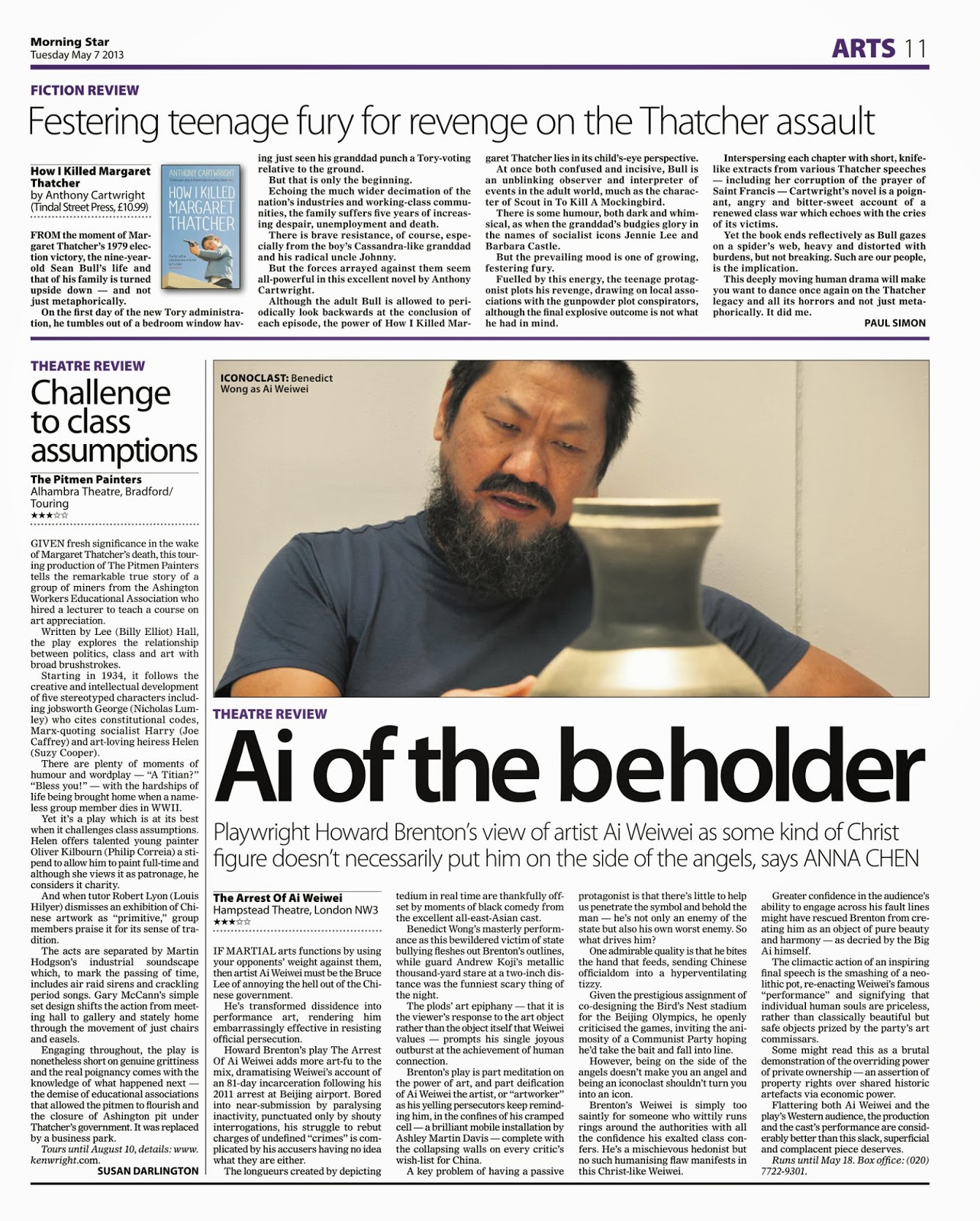
In the Ai of the beholder: my theatre review of The Arrest of Ai Weiwei
The Arrest of Ai Weiwei
Hampstead Theatre, London NW3
If martial arts functions by using your opponents' weight against them, then artist Ai Weiwei must be the Bruce Lee of annoying the hell out of the Chinese government.
He's transformed dissidence into performance art, rendering him embarrassingly effective in resisting official persecution.
Howard Brenton's play The Arrest of Ai Weiwei adds more art-fu to the mix, dramatising Ai's account of an 81-day incarceration following his 2011 arrest at Beijing airport. Bored into near-submission by paralysing inactivity punctuated only by shouty interrogations, Ai's struggle to rebut charges of undefined "crimes" is complicated by his accusers having no idea what they are either.
The longeurs created by depicting tedium in real time are thankfully offset by moments of black comedy from the excellent all-east-Asian cast.
Benedict Wong's masterly performance as this bewildered victim of state bullying fleshes out Brenton's outlines, while guard Andrew Koji's metallic thousand-yard stare at a two-inch distance was the funniest scary thing of the night.
The plods' art epiphany — that it is the viewer's response to the art object rather than the object itself that Ai values — prompts his single joyous outburst at human connection achieved.
Brenton's play is part meditation on the power of art, and part deification of Ai Weiwei the artist — or "artworker" as his yelling persecutors keep reminding him in the confines of his cramped cell, a brilliant mobile installation by Ashley Martin Davis, complete with the collapsing walls on every critic's wish-list for China.
A key problem of having a passive protagonist is that there's little to help us penetrate the symbol and behold the man: not only an enemy of the state but also his own worst enemy. So what drives him?
One admirable quality is that he bites the hand that feeds, sending Chinese officialdom into a hyperventilating tizzy.
Given the prestigious assignment of co-designing the Bird's Nest Stadium, he'd openly criticised the Beijing Olympics, inviting the animosity of a Communist Party hoping he'd take the bait and fall into line.
However, being on the side of the angels doesn't make you an angel, and being an iconoclast shouldn't turn you into an icon.
Brenton's Weiwei is simply too saintly for someone who wittily runs rings around the authorities with all the confidence his exalted class confers. He's a mischievous hedonist, but no such humanising flaw manifests in this Christ-like Weiwei.
Greater confidence in the audience's ability to engage across his faultlines might have rescued Brenton from creating him as an object of pure beauty and harmony — as decried by the Big Ai himself.
The climactic action of an inspiring final speech is the smashing of a neolithic pot, reenacting Ai's famous 'performance' signifying that individual human souls are priceless, rather than classically beautiful but safe objects prized by the party's art commissars.
Some might read this as a brutal demonstration of the overriding power of private ownership — an assertion of property rights over shared historic artefacts via economic power.
Flattering both Ai Weiwei and the play's western audience, the production and cast performance are considerably better than this slack, superficial and complacent piece deserves.
Runs at the Hampstead Theatre until May 18. Box office: 020 7722 9301
Friday, 27 April 2012
Ai Weiwei's cactus and crab packs political punch

Ai Weiwei has another work on show in London: a living sculpture, "The Box", consisting of a crab and a cactus in the small confined space of a white box (the artist has been incarcerated for months at a time in China) is at the Pippy Houldsworth Gallery from today.
As with the box, the significance of the prickly cactus is fairly easy to work out but what some Western commentators may me missing is what the crab may mean, especially if it turns out to be a river crab. The gallery had to search around for the right kind of cactus as stipulated by Ai. I do hope they managed to obtain a Chinese mitten crab — the river crab — as this carries an extra layer of meaning in written Chinese: harmony which has become synonymous with censorship.
In Chinese Mandarin, the word "River crab" (河蟹), which originally means Chinese mitten crab, sounds similar to "Harmonious/Harmonize/Harmonization" (Chinese: 和谐) in the word "Harmonious society" (和谐社会), Chinese leader Hu Jintao's signature ideology.
Along with "grass mud horse" (meaning yo mama's anatomy), river crabs have been used for years by China's netizens to goad the Chinese government. Let's hope they let him out for the launch of his pavilion at the Serpentine Gallery in London this summer.
For your edification and amusement, here's The Song of the Mud Grass Horse which makes South Park look like Enid Blyton.
Ai Weiwei's The Box is at the Pippy Houldsworth Gallery, 6 Heddon Street, London W1, 27 April - 26 May 2012.
Sunday, 15 May 2011
Ai Weiwei at Somerset House: Jimmy Porter and heads on a stick


A visit to disappeared artist Ai Weiwei's 12 Circle of Animals/Zodia Heads at Somerset House off the Strand in London proves well worthwhile.
The huge bronze animal heads representing the 12 animals of the Chinese Zodiac have been erected in a suitably impressive setting, standing tall along three sides of the courtyard fountains in this classical 18th century square.
They are based on the heads stolen from the Yuanming Yuan Imperial Palace fountain by the British and French during the second Opium War (1856-60), and are a meditation on looting, the fake and the copy.
Here's an Ai Weiwei moment from British culture — Jimmy Porter, protagonist of John Osbourne's Look Back In Anger from 1956. Kenneth Tynan reviews:
What with this flair for introspection, his gift for ribald parody, his excoriating candour, his contempt for "phoniness", his weakness for soliloquy and his desperate conviction that the time is out of joint, Jimmy Porter is the completest young pup in our literature since Hamlet, Prince of Denmark. ... Jimmy is simply and abundantly alive: that rarest of dramatic phenomena, the act of original creation has taken place: and those who carp were better silent. Is Jimmy's anger justified? ... The Porters of our time deplore the tyranny of "good taste" and refuse to accept "emotional" as a term of abuse; they are classless and leaderless.
Ai's Circle of Animals/Zodiac Heads is on exhibition at Somerset House until 26 June. Free entry but the series of talks to accompany the exhibition are £10 each.
UPDATE Monday 16 May: Index on Censorship reports that Ai has been seen by his wife, has had his diabetes medicine, and still has his signature beard even though prisoners are usually shaved.
Wednesday, 11 May 2011
Ai Weiwei: the Monkey King goes missing

Épater la bourgeoisie. Scare the rich and powerful until their pips squeak. That's always been a healthy drive for anyone with a democratic bone under their flab, and one that turned me into a London punk back in the day. Another guiding principle is that no-one should be locked up for thought crimes. When you crush ideas, the energetic vanguard that expands our society's possibilities, you crush humanity's potential for growth.
The awarding of the Nobel Peace Prize to Liu Xiaobo certainly strained my inner Voltaire once I'd read what this unpleasant cheerleader for Nato's wars had actually written. No wonder you couldn't find in-depth pieces expounding his worldview in the Western media. As Tariq Ali revealed in Counterpunch:
Liu Xiaobo has stated publicly that in his view:
(a) China's tragedy is that it wasn't colonised for at least 300 years by a Western power or Japan. This would apparently have civilised it for ever;
(b) The Korean and Vietnam wars fought by the US were wars against totalitarianism and enhanced Washington's 'moral credibility';
(c) Bush was right to go to war in Iraq and Senator Kerry's criticisms were 'slander-mongering';
(d) Afghanistan? No surprises here: Full support for Nato's war.
As much as I recoil from another laughable Nobel Peace Prize that goes, in the tradition of Henry Kissinger's award, beyond satire, I defend Liu's right to say those things, just as I reserve the right to blow raspberries right back at him.
However, Ai Weiwei is another case. He's not just a very bright and talented artist: he looks the kind of guy you'd like personally and would want to have a beer with. Witty, gutsy, principled, original, courageous and entertaining: not for him vapid decorative art. Ai picks on the powerful and the bullies, comforting the afflicted and afflicting the comfortable. When children died in school-buildings so shoddily constructed with illegal 'tofu' cement that they collapsed in the Sichuan earthquakes, he made this scandal a feature of one of his works.
Instead of the authorities taking this as a kick up the rear to do their job and prevent corruption resulting in such devastating consequences, they added this to the list of his 'crimes'. Who is it who's defending the Chinese people in this case? It's certainly not the time-serving bureaucrats who are persecuting Ai.
If only the Britpop art pack could claim such a powerful raison d'etre.
Ai's mischief with intent has a cultural precedent in Sun Wukong, the Monkey King, whose adventures have delighted and inspired Chinese children for hundreds of years since the classical tales of Journey To The West were written in the 1590s. A cross between Prometheus and Tigger, the irrepressible Monkey King upsets the balance of heaven and experiences various adventures and punishments on his path to enlightenment. In doing so, he takes us along with him.
Heaven – in the form of the Communist Party – is certainly upset now. Stung into retribution by a man who refuses to accept his place in the hierarchical firmament, they've gone a bit nuts in their lashing-out. Even the UK Chinese who usually steer clear of the politics of the mainland are openly derisive about Ai Weiwei's mile-long charge sheet. 'The Chinese authorities are desperate and are throwing everything at him,' said one UK Chinese local politician in London. He's been accused of everything from tax evasion to plagiarism, a ridiculous notion considering this is a man on a mission burning with fresh ideas. I suspect that the artist who designed the beautiful Bird's Nest Stadium in Beijing, and who gave us millions of hand-painted ceramic sunflower seeds at the Tate Modern, doesn't need to steal from anyone.
It's not as if China is in a state of crisis, a fledgling state seeking equilibrium in its early days. A state will use any means necessary to protect itself, just as Great Britain did during its world wars when its population were warned continuously that walls have ears and paranoia was seen as a sensible defensive measure. China is set to be the biggest economic power of the 21st century, with its luckier natives too busy making money to care about politics. If it's not feeling secure now, when will it ever?
With the banning in America of Tony Kushner and other playwrights critical of Israel, the West can't crow over any absolute right to freedom of speech. At least Peter Kosminski was only excoriated for his brilliant four-part Channel 4 drama on the history of the Palestine conflict, The Promise, and not banned here. However, it took a Twitter campaign to challenge the secretive superinjunctions in the UK which protected the moneyed hypocrites who espoused family values. Left to their own devices, the politicians proved inadequate to the task when the judiciary decided what we could and couldn't know, and it was the collective spontaneity of an 'I Am Spartacus' blizzard of tweets that may have, for once, checked our draconian libel laws.
The Chinese should be proud that they now have a society which can produce such a challenging character, because we have none here any more. They should be nurturing people like Ai Weiwei, and treating him like the national treasure that he is. On second thoughts, that might kill his fight impulse with kindness, so ultimately, their persecution is probably the best thing that could happen to his art. If this latest incarceration since 3rd April hasn't extinguished his spark and destroyed the human being, it will be a very angry man who emerges from imprisonment, and I look forward to seeing what he produces.
And the authorities will have only themselves to blame.
Ai Weiwei's work will be on display at the Lisson Gallery from tomorrow until 16th July.
52-54 Bell Street, London, NW1 5DA
T: + 44(0)20 7724 2739
F: + 44(0)20 7724 7124
Ai's Circle of Animals/Zodiac Heads is on exhibition at Somerset House from tomorrow. Free entry but the series of talks to accompany the exhibition are £10 each.
Police, Party and Punishment in China
Ai Weiwei's Sunflower Seeds at Tate Modern
Subscribe to:
Posts (Atom)
