Showing posts with label BBC Radio 4 Extra. Show all posts

Saturday, 10 December 2016

BBC Radio 4 Extra to repeat ST IVES AND ME Wed 21st Dec 6.30am, 1.30pm and 8.30pm: presented by Anna Chen

Spend the longest night of the year with me on BBC Radio 4 Extra when St Ives and Me is repeated on December 21st


ST IVES AND ME on BBC Radio 4 Extra.

I've just learnt from my lovely producers, Mukti Jain Campion and Chris Eldon Lee at Culture Wise, that my BBC R4 programme about the history of artists in St Ives, Cornwall, is on again.

BBC Radio 4 Extra is repeating St Ives and Me on Wednesday 21st Dec 6.30am, 1.30pm and 8.30pm. And there may even be one at 1.30 the next morning if you haven't had enough of me by then or have rolled in merry from Christmas season fun and frolix and are in need of entertainment.

Available after broadcast here.

The original broadcast in 2011 was Pick of the Day for the Radio Times, The Times, Daily Telegraph, Daily Mail, Observer and the Independent.

St Ives, a Cornish seaside town 300 miles from comedian and poet Anna Chen's London home has been attracting artists for two centuries. A varied assortment of eccentrics, entrepreneurs and free spirits have turned the pilchard-fishing and tin-mining town into a popular cultural haven.

Anna has been holidaying there since she was ten and knew many of the famous artists who've populated and popularised St Ives.

In the late 1970s the bohemian fashion journalist and novelist Molly Parkin was a regular on the St. Ives scene and she recalls how, in the dark recesses of Mr Peggotty's disco, she introduced Anna to artist Patrick Heron. In his Porthmeor studio by the Atlantic, Heron used to make Anna mugs of tea while he painted and sketched her and their conversations opened her eyes to the arts. Revisiting those studios, she meets two present day painters maintaining the St Ives' tradition.

On a personal tour of the town, she returns to Barbara Hepworth's sculpture garden, hears about the unique light conditions that attract so many artists and reveals the vital roles Napoleon, Von Ribbentrop and the 1960s hippies played in promoting and preserving St Ives.

At lunchtime, in Norway Square, Anna performs her comic poetry in the St Ives Festival, which has been attracting trendsetters for thirty years.

And she waits on the beach, with bated breath, for the legendary 33rd wave.

Producer: Chris Eldon Lee
A Culture Wise production for BBC Radio 4.

I may even be reading a bit of poetry. Here are a few photos from St Ives September 2011. For more pix, go here.

At Tate St Ives for Martin Creed's balloon installation


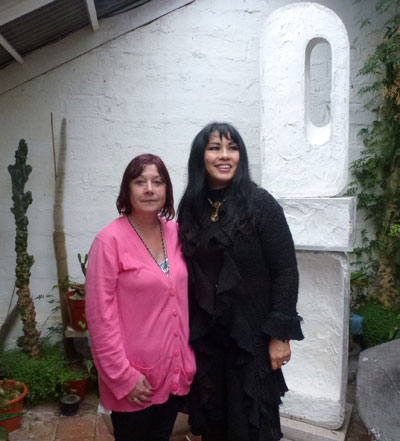
Jan Jefferies and Anna


Denise and Steve Ingamells at Tate St Ives

Jan Jefferies and Charles Shaar Murray at Tate St Ives

Producer Chris Eldon-Lee interviews Valerie Hurry in the Tate St Ives Rotunda


Chris recording in Fore Street, St Ives


Chris reads at a St Ives festival session in Norway Square.
Also present, artists Bob Devereux, Keir Williamson
and the late, much missed Colin Birchall

Bob Devereux hosts the St Ives Festival lunchtime sessions in Norway Square.
With Marc Jefferies and Charles Shaar Murray


Lol in Norway Square


Rod Bullimore, Norway Square, St Ives

Buffalo Bill Smith and Colin Birchall at the Frug in the St Ives Arts Club


With Clare Wardman in the studio she shares with Iain Robertson

Clare and Iain's view over the beach from Porthmeor Studios

Charles Shaar Murray in The Hub

Anna and Jan in Barbara Hepworth's conservatory

Anna and Jan on the Island below St Nicholas Chapel

Charles Shaar Murray and Chris Eldon Lee in The Mermaid


Jan, Anna and Denise in The Mermaid
Sunset over Porthmeor Beach and the Clodgy
INTERVIEWEES:

Molly Parkin
Bob Devereux
Valerie Hurry
Steve Dove
Tony Carver
Jo McIntosh
Denise Ingamells
Annie Jackson
Iain Robertson
Clare Wardman

MUSIC AND PERFORMANCE
Charles Shaar Murray and Buffalo Bill Smith — Walking Blues by Robert Johnson
Charles Shaar Murray — Dylan in '66
Bob Devereux — Queen of the Gypsies; Oak
Lol accompanying Bob Devereux
Rod Bullimore — Last Orders; Sewage Against Surfers
Anna Chen — Ode to a Detox on Leaving St Ives; Kicking a Dinosaur

Anna's poetry collection, Reaching For My Gnu is available here

More information on Anna's radio programmes here

Tuesday, 15 March 2016

Another chance to hear Anna May Wong: A Celestial Star in Piccadilly on BBC Radio 4 Extra and iPlayer

Anna May Wong: a celestial star in Piccadilly, BBC Radio 4 Extra, 06:30 & 13:30 Wednesday 16th March 2016. Written & presented by Anna Chen


I had the great pleasure to make my programme on Anna May Wong, Hollywood's first Chinese screen legend, in 2008 for broadcast on BBC Radio 4 in January 2009. It's repeated on BBC Radio 4 Extra tomorrow, Wednesday 16th March at 06:30 and 13:30, then on iPlayer for 30 days.


Anna Chen writes and presents A Celestial Star In Piccadilly, a half-hour profile of Hollywood's first Chinese movie star for BBC Radio 4.
First Broadcast 11:30am, Tuesday 13th January 2009.
Pick of the Day in Guardian Guide, Daily Mail and Mail on Sunday.

LISTEN AGAIN ONLINE FOR 30 DAYS AFTER BROADCAST HERE

While I was growing up in Hackney, there were few east asian women in the culture reflecting anything like my appearance. Those that did slip through were not necessarily an inspiration. Yoko Ono was unfairly reviled in the media as a hate figure, although – far from breaking up the Beatles –she was a respected Fluxus artist in her own right and famous among the avant-garde cognoscenti way before John Lennon was anything more than a pop star. The twin horrors of my childhood, Suzy Wong and Juicy Lucy – happy hookers who migrated from popular literature onto the screen – were always there to define me in the eyes of a society without any other reference points. There were powerful women, too, but they came in the shape of Jiang Qing (Madam Mao), the kleptocratic Imelda Marcos and, in fiction, the evil daughter of Fu Manchu. Her I quite liked.

I wondered who the young Anna May Wong had to look up to. She grew up as third-generation Chinese born in a youthful America when Native Americans were safely out of the way on their reservations and former slaves were consigned to ghettos and plantations. Chinese-Americans were about as low as you could get; depicted as so much of a danger to working men and decent citizens that the US government introduced legislation specifically designed to curb the ambitions of the Yellow Peril within. Their ambitions may have been humble — earning an honest dollar for one's labour, living in safety and security, bringing up families of their own — but the owners of capital tolerated them only as cheap labour, while much of the labour movement in both the Britain and the USA (Wobblies excluded) saw the Chinese as more of a threat than as fellow workers.

Various schools of thought say that Asiatic humans first walked over the Beriing Straits more than 17,000 years ago and populated the Americas down to their southernmost tip. Others contend that Imperial Chinese ships arrived in the 15th century, predating Columbus by decades; or that they initially landed in California on Portuguese ships carrying silver from mines in the Philippines.

What we do know is that in the mid-19th century, the discovery of gold at Sutters Mill in 1848 drew first a trickle and then a flood of Chinese who joined in the Gold Rush, populating the west coast and working the mines in the Sierra Nevada mountains. The next wave of immigration was brought in as cheap coolie labour by Charles Crocker in the 1860s to build his Central Pacific railroad which would link Sacramento with the East and bring the West into the Union during the Civil War. Conditions were harsh and they were paid less than their white counterparts.

But not all Chinese would submit and conform to the role of coolie; there was one major strike with thousands laying down tools as they busted through granite mountains and worked in 20-foot snowdrifts. It was a strike that had the potential to unite all workers, and ever since I found out about it in the early 1990s while working with Sinophile author Martin Booth on his film script The Celestial Cowboys in 1993, it has inspired me, especially as there are those who insist that Chinese are genetically bourgeois and incapable of working-class consciousness. The strikers were eventually starved back to work with a few concessions but they had shown they they weren’t all pushovers.

Many miners and railworkers settled in the US and formed America’s first Chinese communities. These were Anna May Wong’s roots.

In a world bereft of role models, Anna May carved out an acting career in the early days of the Hollywood film industry. She started young, as an extra on the streets of Los Angeles, learning her craft and gaining proper roles in defiance of her traditionalist father, who wanted her at home in the family laundry.

By 17, she was starring in Hollywood’s first technicolour movie, The Toll of the Sea, as the Madame Butterfly character, “marrying” an American who promptly dumps her when he returns to his homeland and a white wife. She dies tragically at the climax, beginning a pattern that would endure for most of her career.

Trapped in Dragon Lady or Lotus Blossom roles, she grew tired of being demeaned, insulted and limited. Anti-miscegenation laws meant she wasn’t allowed to kiss a romantic lead if he was white, even if he was a white actor playing a Chinese. Your sexuality got you killed, at least symbolically.

In the late 1920s she came to Britain, where she was already a huge star and made the black and white silent feature film Piccadilly for the German director E A Dupont. This was perhaps her greatest starring role, but she still had to die at the end. Death was the fate she had to endure for the crime of being attractive. I take a closer look at this movie in the programme as there’s a plethora of prejudice leaking at the edges, some of it hilarious, much of it still extant today.

Anna May was the toast of Europe: mates with Paul Robeson, Josephine Baker, Marlene Dietrich and, strangely, Leni Riefenstahl. Such was the contrast in Europe with what she’d experienced back home that she once stated there was no racism in Germany. And that was in the Thirties, which gives you some idea how bad it must have been if you were a minority in the Land of the Free.

She starred with Marlene Dietrich in Shanghai Express, acted with a greenhorn Laurence Olivier on the London stage. Philosopher Walter Benjamin had a major crush on her. She dined with royalty and was adored by her fans. Eric Maschwitz wrote the classic song “These Foolish Things” about her.

Yet Hollywood still refused to lower the drawbridge and give her the starring roles she deserved. Those still went to white actresses in Yellowface. Myrna Loy as evil Daughter of Fu Manchu? Loy, Katherine Hepburn, Luise Rainer and Tilli Losch were all considered better at being Chinese than Anna May Wong.

These things take their toll and she died in 1961, at the unnervingly early age of 56.

But isn’t everything different today? Nope, it’s still with us. The form has mutated but the content lives on. A Celestial Star in Piccadilly is one case study in how minorities are rendered invisible in the culture and as producers of culture, while the fruits of their labour are appropriated by those who sit at High Table.

And the danger of that is it’s the sleep of reason where monsters are born.

Hmmm, sounds familiar and rather too close to home ...

Interviewees include:
Graham Russell Gao Hodges, Anna May Wong's biographer, Laundryman's Daughter
Diana Yeh, historian
Alice Lee, writer and actress who performed her one woman show about Anna May Wong, Daughter of the Dragon
Elaine Mae Woo, director of Frosted Yellow Willows about Anna May
Ed Manwell, film producer, Frosted Yellow Willows
Neil Brand, composer of the new score for the BFI Southbank rerelease of Piccadilly on DVD
Jasper Sharp, east Asian film expert
Kevin Brownlow, legendary film historian and filmmaker
Margie Tai and Connie Ho, who remember Anna May Wong visiting their Limehouse neighbourhood when they were kids

Produced by Chris Eldon Lee for Culture Wise Productions
Many thanks to Mukti Jain Campion of Culture Wise for giving me latitude and for her feedback


AVAILABLE TO LISTEN FOR 30 DAYS AFTER BROADCAST HERE

ShareThis