Showing posts with label art. Show all posts

Saturday, 10 December 2016

BBC Radio 4 Extra to repeat ST IVES AND ME Wed 21st Dec 6.30am, 1.30pm and 8.30pm: presented by Anna Chen

Spend the longest night of the year with me on BBC Radio 4 Extra when St Ives and Me is repeated on December 21st


ST IVES AND ME on BBC Radio 4 Extra.

I've just learnt from my lovely producers, Mukti Jain Campion and Chris Eldon Lee at Culture Wise, that my BBC R4 programme about the history of artists in St Ives, Cornwall, is on again.

BBC Radio 4 Extra is repeating St Ives and Me on Wednesday 21st Dec 6.30am, 1.30pm and 8.30pm. And there may even be one at 1.30 the next morning if you haven't had enough of me by then or have rolled in merry from Christmas season fun and frolix and are in need of entertainment.

Available after broadcast here.

The original broadcast in 2011 was Pick of the Day for the Radio Times, The Times, Daily Telegraph, Daily Mail, Observer and the Independent.

St Ives, a Cornish seaside town 300 miles from comedian and poet Anna Chen's London home has been attracting artists for two centuries. A varied assortment of eccentrics, entrepreneurs and free spirits have turned the pilchard-fishing and tin-mining town into a popular cultural haven.

Anna has been holidaying there since she was ten and knew many of the famous artists who've populated and popularised St Ives.

In the late 1970s the bohemian fashion journalist and novelist Molly Parkin was a regular on the St. Ives scene and she recalls how, in the dark recesses of Mr Peggotty's disco, she introduced Anna to artist Patrick Heron. In his Porthmeor studio by the Atlantic, Heron used to make Anna mugs of tea while he painted and sketched her and their conversations opened her eyes to the arts. Revisiting those studios, she meets two present day painters maintaining the St Ives' tradition.

On a personal tour of the town, she returns to Barbara Hepworth's sculpture garden, hears about the unique light conditions that attract so many artists and reveals the vital roles Napoleon, Von Ribbentrop and the 1960s hippies played in promoting and preserving St Ives.

At lunchtime, in Norway Square, Anna performs her comic poetry in the St Ives Festival, which has been attracting trendsetters for thirty years.

And she waits on the beach, with bated breath, for the legendary 33rd wave.

Producer: Chris Eldon Lee
A Culture Wise production for BBC Radio 4.

I may even be reading a bit of poetry. Here are a few photos from St Ives September 2011. For more pix, go here.

At Tate St Ives for Martin Creed's balloon installation


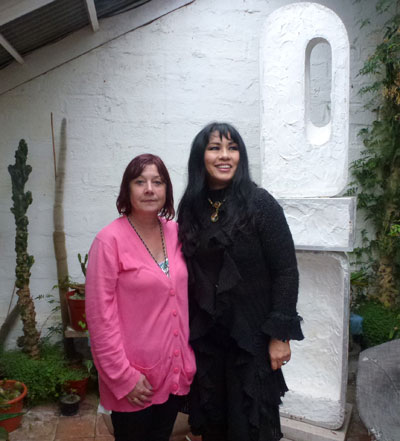
Jan Jefferies and Anna


Denise and Steve Ingamells at Tate St Ives

Jan Jefferies and Charles Shaar Murray at Tate St Ives

Producer Chris Eldon-Lee interviews Valerie Hurry in the Tate St Ives Rotunda


Chris recording in Fore Street, St Ives


Chris reads at a St Ives festival session in Norway Square.
Also present, artists Bob Devereux, Keir Williamson
and the late, much missed Colin Birchall

Bob Devereux hosts the St Ives Festival lunchtime sessions in Norway Square.
With Marc Jefferies and Charles Shaar Murray


Lol in Norway Square


Rod Bullimore, Norway Square, St Ives

Buffalo Bill Smith and Colin Birchall at the Frug in the St Ives Arts Club


With Clare Wardman in the studio she shares with Iain Robertson

Clare and Iain's view over the beach from Porthmeor Studios

Charles Shaar Murray in The Hub

Anna and Jan in Barbara Hepworth's conservatory

Anna and Jan on the Island below St Nicholas Chapel

Charles Shaar Murray and Chris Eldon Lee in The Mermaid


Jan, Anna and Denise in The Mermaid
Sunset over Porthmeor Beach and the Clodgy
INTERVIEWEES:

Molly Parkin
Bob Devereux
Valerie Hurry
Steve Dove
Tony Carver
Jo McIntosh
Denise Ingamells
Annie Jackson
Iain Robertson
Clare Wardman

MUSIC AND PERFORMANCE
Charles Shaar Murray and Buffalo Bill Smith — Walking Blues by Robert Johnson
Charles Shaar Murray — Dylan in '66
Bob Devereux — Queen of the Gypsies; Oak
Lol accompanying Bob Devereux
Rod Bullimore — Last Orders; Sewage Against Surfers
Anna Chen — Ode to a Detox on Leaving St Ives; Kicking a Dinosaur

Anna's poetry collection, Reaching For My Gnu is available here

More information on Anna's radio programmes here

Thursday, 16 June 2016

A Beautiful Disorder: Chinese sculptors exhibited in Britain for first time

This could be good.

Exhibition — A Beautiful Disorder


3 July—6 November, 2016
Grounds and Galleries
The Cass Sculpture Foundation
New Barn Hill
Goodwood
Chichester PO18 0QP
Free with general entry

Cass Sculpture Foundation is delighted to present A Beautiful Disorder, the first major exhibition of newly commissioned outdoor sculpture by contemporary Greater Chinese artists to be shown in the UK.

From July 2016, sixteen monumental outdoor sculptures will be on display throughout the grounds of CASS. These artists employ a variety of ambitious sculptural techniques across a range of materials including bronze, stone, steel and wood.

The historical relationship between English and Chinese landscape aesthetics is the starting point and inspiration for these contemporary Chinese and Greater Chinese artists. The title of the exhibition, A Beautiful Disorder, is a quote from an influential letter written by the Jesuit missionary and artist Jean-Denis Attiret in 1743 that had a tremendous effect on English garden culture. Attiret used the term to describe the ability of the Chinese garden to provoke violent and often opposing sensations in the viewer through a series of theatrical framing devices. The exhibition invites the viewer to reflect on China's past, present and future relationship with the world at large, and provides valuable insight into the state of Chinese culture, politics and society today from the perspective of some of its most dynamic and engaging artists.

Cass Sculpture Foundation’s Executive Director, Clare Hindle, says:

“To date, Cass Sculpture Foundation has commissioned over 400 works – A Beautiful Disorder is a landmark moment for the Foundation as it is the first time we are commissioning works for a major exhibition by international artists. The exhibition will showcase contemporary Chinese sculpture by some of the leading Chinese artists.”

Participating artists for A Beautiful Disorder include: Bi Rongrong, Cao Dan, Cao Fei Cheng Ran, Cui Jie, Jennifer Ma Wen, Li Jinghu, Lu Pingyuan, Xu Zhen (Produced by MadeIn Company), Rania Ho, Song Ta, Tu Wei-Cheng, Wang Sishun, Wang Wei, Wang Yuyang, Zhang Ruyi, Zheng Bo and Zhao Yao.


Sunday, 12 June 2016

Helena Bonett's Tate film of Barbara Hepworth's Trewyn Studio in St Ives screened


I'm delighted to learn that Helena Bonett's film of Barbara Hepworth's Trewyn Studio — now a Tate St Ives museum — includes a clip of my 2006 video (above) and is now out doing the rounds. Next screening 15th June at Porthmeor Studios in St Ives.

From the DVD cover:
Trewyn Studio in St Ives, Cornwall, is where the British modernist sculptor Barbara Hepworth lived and worked from 1949 until her death in May 1975. Transformed into a museum by her son-in-law Sir Alan Bowness, later director of the Tate Gallery, it opened to the public in April 1976 and has been managed by Tate since 1980. 
This film, produced as part of the Tate St Ives Artists Programme, presents Bowness's memories of Trewyn Studio and its establishment as the Barbara Hepworth Museum and Sculpture Garden, using still and moving images to explore queations of time, materiality and legacy. 
A film by Helena Bonett in collaboration with Jonathan Law, 2015, 52 minutes.
Made possible by the Tate St Ives Artists Programme

I have a copy of the DVD which I've watched and enjoyed but sadly it's only available for private viewing and public screenings through the filmmaker.

In the meantime, you'll have to make do with mine. If you like my 2006 video, here's one from 2013:


Keep up to date with Helena Bonett's Twitter


Wednesday, 24 December 2014

How St Ives came to be one of Britain's foremost art communities


St Ives in Cornwall romps home as the ideal town where most of us would like to live. 'Fonly it wasn't also the most expensive.

Here's a piece I wrote about the artists' colony and Number One desirable seaside resort for the recent First Great Western magazine (Sept-Dec 2014).

ST IVES - PORT OF INSPIRATION
Anna Chen on how St Ives came to be one of the most important art communities in the country


It was the sunshine that did it, and not just because it gave you a tan, either. The late Patrick Heron, renowned British painter, claimed that the unique quality of the light in St Ives helped turn a fishing town up the far end of the British Isles into, not only one of our best-beloved seaside resorts, but also a magnet for some of our finest artists.

The most famous among them included the sculptor Barbara Hepworth, whose studio and sculpture garden you can visit tho this day, and her husband, painted Ben Nicholson.

St Ives sits on a peninsula surrounded on three sides by the Atlantic. The higher than normal level of ultra-violet reflected off the ocean creates a bright, luminous quality that has attracted artists for over two hundred years, ever since 1811, when JMW Turner — acclaimed for his ethereal landscapes — first arrived with his charcoal and water-colours.

St Ives in Turner's time had grown wealthy as a major fishing port, benefiting from abundant shoals of mackerel, herring and pilchards drawn to the red run-off from the tin-mines, with the pilchards pressed for oil and mostly exported to Italy. You can still see signs of its once-thriving industry today in the fishermen's nets and brightly coloured buoys in the yard of the Porthmeor Studios, although many of the former pilchard cellars are now holiday homes.

Fashionable British artists in the late 18th and early 19th centuries would have traditionally visited France to paint their favoured French landscapes. But with the outbreak of the Napoleonic wars in 1803, they were soon deprived of their annual sojourns, and looking for an alternative to the rugged Brittany coastline, artists turned to the rocky headlands and high cliffs of Cornwall.

Isambard Kingdom Brunel's Royal Albert Bridge, which spans the River Tamar, connecting Devon with Cornwall, opened in 1859 and flung wide the floodgates for a new generation of British and international artists wanting to follow the great Turner's footsteps. By the time the Great Western Railway connected St Erth with St Ives on 1st June 1877, artists were flocking to the fishing town. Artists such as Walter Sickert and the American JAM Whistler visited in 1884, drawn to the mild weather, wild landscape and, of course, that extraordinary light.

The arrival of the railway not only brought swathes of artists to the area, but also helped bring new opportunities to the town, which was falling into decline in the second half of the 19th century, due to a collapsing fishing industry. The improved transport routes connected the ailing town directly with London Paddington, opening it up as a tourist resort and an outpost for creative types.

The burgeoning artists colony started taking over the abandoned fish cellars and sail lofts, turning them into studios, with the first ever recorded conversion being a sail-loft on Carncrows Street converted by the Right Honourable Duff Tolamache in 1884. The north-facing Porthmeor Studios in Back Road West, overlooking the beach, were particularly well situated, as the light is evenly dissipated, with none of the harsh distorting shadows of a southerly aspect. More to the pojnt, they enjoy a glorious uninterrupted view of the sea and the setting sun over Clodgy Point.

James Lanham opened the first gallery in St Ives in 1887, and the inaugural School of Painting opened the following year, founded by painters Julius Olsson and Louis Grier. Special trains were laid on to bring painters and audiences to exhibitions, assuredly putting St Ives on the map as an international arts hotspot.

The best-known local artist, Alfred Wallis, was discovered painting in the doorway of his home in Back Road West by artists Ben Nicholson and Christopher Wood in 1928. He was a scrap merchant and fisherman who painted straight onto board and bits of metal. They were struck by his unschooled "primitive" naive style and did their best to promote him. Nevertheless, despite their efforts, he sold few paintings in his lifetime and died in the workhouse. His simple grave in Barnoon Cemetary next to Tate St Ives is adorned with ceramic tiles by the potter Bernard Leach.

Leach himself had studied pottery in Japan and brought his techniques to St Ives in 1920 where, with Shoji Hamada, he established the Leach Pottery on the Stennack River. Utilitarian and functional as well as beautiful, his pioneering style earnt him the title "Father of British studio pottery". He died in 1979, but there remains a working Leach studio and gallery celebrating his life and work, as well as showcasing its produce and training a new generation of potters.

Leach received the Freedom of the Borough of St Ives in 1968, the same year as another giant of British art accepted that very accolade — the Modernist sculptor Barbara Hepworth.

Hepworth moved from London to St Ives with her husband Ben Nicholson and their triplets at the outbreak of the Second World War. She lived in the town until her death in 1975, and was the centre of an influential group of abstract artists, including Nicholson, Wilhelmina Barnes-Graham, Peter Lanyon, John Wells, Patrick Heron and sculptor Nuam Gabo. Their exciting and experimental movement, while on the whole largely abstract, still remained rooted in nature, thus giving it a broad appeal.

With a resident art community now in place, other artists were encouraged to visit the town. The Irish painter Francis Bacon worked in studio 3 in Porthmeor Studios between September 1959 and January 1960, also visited for three days in 1959. Other artists include Roger Hilton, Terry Frost, Paul Feiller and Sandra Blow who worked from Porthmeor Studios from 1994 and then Bullens Court.

In 1993, the Tate St Ives gallery opened to the public, sealing the town's reputation as a world class centre for art. The gallery continues to have an extensive programme of exhibitions and events, and for the next seven months will be home to some of the best photography from the Tate collection in a new exhibition entitled The Modern Lens: International Photography and the Tate Collection.

The Tate also runs the Barbara Hepworth Museum and Scupture Garden (her former home and studio) at the Trenwyn Studio, as well as offering a multimedia Ben Nicholson tour.

For over 200 years, St Ives has been attracting some of the best British and international artists to its rocky shores. Drawn to the unique quality of its light, painters and sculptors settled in the town where they created and exhibited theirnwork while raising families and contributing to the community. They made full use of everything the area had to offer, and while there, undoubtedly got a bit of a tan too.

* * *

ARTISTS: Alfred Wallis, Borlase Smart, Patrick Heron (worked at Studio 5, Porthmeor Studios), Francis Bacon, Sandra Blow, Patrick Hughes, Naum Gabo, Turner, Barbara Hepworth, Ben Nicholson, John Wells (discovered Alfred Wallis), Bernard Leach, Peter Lanyon, Sven Berlin, Wilhelmina Barns-Graham, Bryan Wynter, Terry Frost, Roger Hilton, Roy Walker. And living: Anthony Frost, Bob Devereux, Keir Williamson, Breon O'Casey, Zoe Eaton, Clare Wardman, Roy Ray, Sax Impey.

Artist Bob Devereux helped start the St Ives Arts Festival some thirty years ago and keeps the tradition alive with the May Litarary Festival which takes place for a week in May.

Art classes can be found at the St Ives School of Painting as well as the Bernard Leach pottery. There's always somthing for children at Tate St Ives.

POTTERY: Aside from the Leach Pottery, the best ceramics shop outside London has to be St Ives Ceramics in Fish Street which carries not only contemporaty work, but also pieces by Leach and his great friend Hamada Shoji, as well as his late widow, Janet. Another pottery well worth visiting is the Gaolyard where you can watch the nine resident potters working.

Patrick Heron occupied Studio 5 Porthmeor Studios. He designed scarves form the age of 14 for his father's textile factory in St Ives. Lived in St Andrew's Street and then Eagles Nest on the road to Zennor. Designed the stained glass window on the ground floor of Tate St Ives: Window For Tate Gallery St Ives 1992–3

Virginia Woolf wrote her novel To The Lighthouse inspired by Godrevy Lighthouse. The Stephens family spent summers at Talland House in Talland Road until Virginia was 13 years old.

Art classes:
St Ives School of Painting
Learn to draw and paint or just keep your hand in at St Ives's oldest art school, established in 1938.

Porthmeor Studios, St Ives, Cornwall
TR26 1NG
t: 01736 797180
e: info@schoolofpainting.co.uk
http://schoolofpainting.co.uk

The Leach Pottery
Beginners and professionals can take short courses in throwing clay throughout the year.
Higher Stennack, St Ives TR26 2HE
Tel: 01736 799703
http://www.leachpottery.com/intensive-courses/

Ultramarine Studio

Back Road Artworks

Back Road East

St. Ives
TR26 1NW


+44(0)1736 791571
www.ultramarine-st-ives.co.uk/painting-classes-in-st-ives.asp

Knit One Weave One
Make an eye-popping fabric picture or a vibrant felt hat with Jo McIntosh's textile art classes.
www.knitweave.co.uk
01736 797122

St Ives Arts Club
As well as holding exhibitions and staging performances in their 120-year old theatre, the club also hosts art classes. Check the website for more info.
Westcott's Quay.
http://www.stivesartsclub.org

Wednesday, 25 June 2014

Help get Art Everywhere: only a few days to vote


Art Everywhere, the UK’s largest art project and most accessible art campaign wants your participation.


Coming back into its’ second year following a successful launch in 2013, Art Everywhere is back, and since June 3, the public have had a few weeks to co-curate the exhibition and vote for their favourite pieces of art from a long list of over 70 British artworks via facebook.com/arteverywhereuk.

Voting ends on 30th June and the shortlist will be announced on 16th July with Grayson Perry and Antony Gormley in attendance. The shortlisted work will be on show across the UK for 6 weeks, sites include; bus stops, airports, train stations, shopping centres and many more locations.

Richard Reed, co-founder of Innocent Drinks and originator of the idea for Art Everywhere, said: “Art Everywhere is back to showcase great British artworks for a summer of art. We want the British public to crowd-fund and vote for their favourites. This year goes bigger and better including a specially created artwork exclusive from a world-renowned artist.”.

Tuesday, 25 March 2014

Chinese arts tonight on Madam Miaow's Culture Lounge, Resonance FM, 5pm

Aowen Jin's Factory Girls

Tonight live at 5pm on Resonance 104.4FM, Madam Miaow's Culture Lounge's guests are actor Daniel York, playwright Jingan Young, and artist Aowen Jin.

Presented by Anna Chen. Charles Shaar Murray rides shotgun. With added Wondermare.


Expect a lively discussion on the conflicting state of Chinese artists in Britain as the West recognises there may be vulgar dosh at stake. And mainland Chinese artist Aowen Jin talks about her work looking at Factory Girls, China's One Child Policy and having Boris Johnson open her Sound Fountain in China.

Live music in the studio from Wondermare, practically my resident house band.

Listen here, live (click on widget) or afterwards online.

Resonance 104.4FM

MUSIC TRACKS:
1) INTRO: WOODY GUTHRIE — I Ain't Got No Home In This World Anymore
[LIVE MUSIC: WONDERMARE — Ode to Billy Joe]
2) ROLLING STONES — Can't You Hear Me Knocking
3) SYL JOHNSON — Is It Because I'm Black?
4) LANG LANG & METALLICA — One (Live at the Grammys 2014)
5) DRAGONFORCE with Herman Li — Through the Fire and Flames
6) AOWEN'S TRACK
[LIVE MUSIC: WONDERMARE — White Horses]
7) FRANK CHICKENS - We Are Ninja

Wednesday, 25 September 2013

A walk around the Barbara Hepworth sculpture garden in St Ives.


Another idyllic trip to St Ives making sure I get in my annual soul-food with several visits to the Barbara Hepworth gallery and sculpture garden in St Ives. A magical place.

With Paul Anderson and Denise Ingamells.

Friday, 24 May 2013

Ellen Gallagher, fat ladies and Pan sex with goat: my week of London kulcher


POMPEII, HERCULANEUM AND ICE AGE ART

In the cultural whirl that's been my life this past week, I've seen not only the sold-out sexily titled Life and Death: Pompeii and Herculaneum exhibition (on until 29 September), I also caught Ice Age Art now in its final weeks: both at the British Museum. Some of the ice-age artefacts go back 31,000 years and, as the curators blast out from the posters, it does indeed mark the arrival of the modern mind.

Female forms abound. Closer to Beryl Cook than Vogue, them were the days when being voluptuous (or as we called it in Hackney, "podgy") made you an object of beauty and the muse of artists. I wonder if those cavemen slept with their models.


The funniest exhibit to have survived the volcanic wrath of Mount Vesuvius in AD 79 is the statue of Pan shagging a goat — a garden ornament, it is believed, and certainly one I'd have frightening the squirrels in my back yard any day. It's a nanny, not a male goat the god of the wild is penetrating, so, hey, at least Pan's not GAY, thus preserving some decorum for the elderly ladies and school parties clogging up the aisles. However, I bet she's under age, thereby opening up another can of net-curtainland anxieties.

But she looks happy enough, and Pan has the manners to take her missionary stylee rather than doggy, so he's showing respect and not a little affection in the way he's playing with her beard. If a guy tugs fondly at your facial hair while making sweet lurve instead of demanding electrolysis, you know you're in with a second date. Up close enough for my breath to steam up the glass case, the wickedness in his smile is achieved with such subtlety that I could swear he winked at me.

ELLEN GALLAGHER

At Tate Modern, I did one last circuit of the Lichtenstein on its last day, quite liked the Saloua Raouda Choucair but fell head over heels in love with Ellen Gallagher who I'd never even heard of before.

Motifs of boggle eyes and big grinning thick-lipped mouths run through her early work and are immediate clues as to her identity as a mixed-race black woman working in the US. She's funny, beautiful and political so that's my fandom sewn up.

Three vast canvasses made up of hundreds of original mid-20th century newsprint magazine adverts targeting American black people sport new hairdos courtesy of the artist made out of bright yellow plasticene in an amusing and imaginative series of ludicrous formations that aren't half as mad as the neuroses those magazines were feeding.


One of my favourite pictures, Abu Simbel, is a mucked around photogravure of the three giant statues of pharoahs sitting outside one of the pyramids. Again, thick minstrel lips, broad noses and boggle eyes are stuck on the pharoahs' faces. Heads of murdered black men tumble in a heap at the base, two nurses smile and three tiny men in suits point feebly at a flying saucer made of yellow plasticene, turquoise fun-fur and spangles shooting its death rays.


Those nurses are referenced throughout Gallagher's earlier work but it wasn't until I read the notes for another big canvas and my overall favourite, An Experiment of Unusual Opportunity (2008), that I realised the significance.

The experiment referred to is the notorious Tuskegee experiment where hundreds of poor black men were deliberately infected with syphylis and observed over 40 years from 1932 with no medical treatment even when penicillin was found to be a cure. Nurse Eunice Rivers was the trusted intermediary between the men and an insane medical establishment.

This work is an abstract, like several other of the 100 or so works on show, made of hundreds of paper strips soaked in blue ink to varying intensities so that the whole surface ripples, and contrasted with  oranges, ochres and umbers. It is the most beautiful thing to look at yet represents one of the ugliest events in modern American history. The reproductions don't do it justice so do see the real deal.

There's a ton more from Gallagher in the huge AxME restrospective, with her tendrilly marine drawings most notable. Don't miss it.

Coming up, Luke Bedford and the London Sinfonietta, and David Henry Hwang's Yellow Face at London's new Park Theatre.

Friday, 10 May 2013

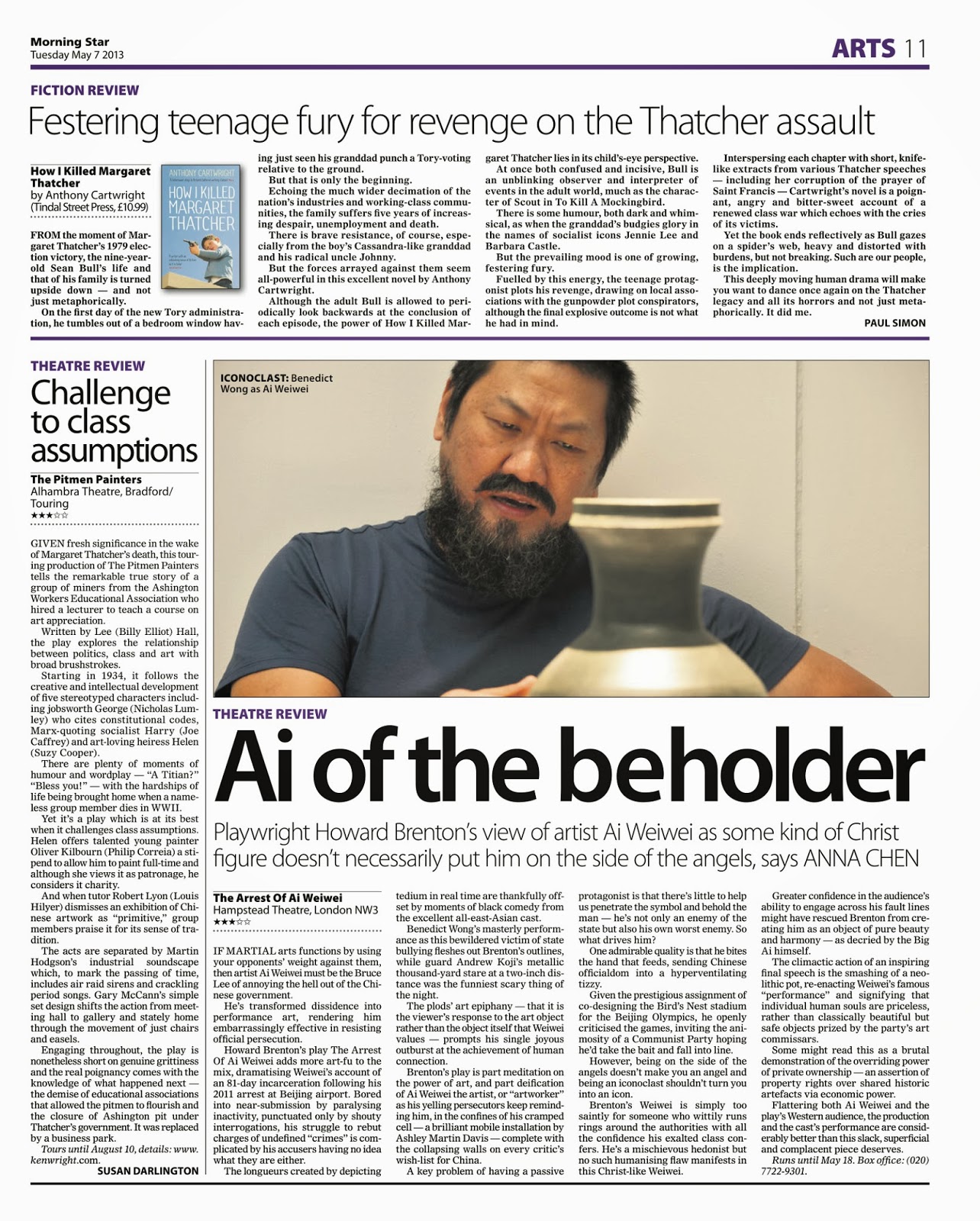
In the Ai of the beholder: my theatre review of The Arrest of Ai Weiwei


The Arrest of Ai Weiwei
Hampstead Theatre, London NW3

If martial arts functions by using your opponents' weight against them, then artist Ai Weiwei must be the Bruce Lee of annoying the hell out of the Chinese government.

He's transformed dissidence into performance art, rendering him embarrassingly effective in resisting official persecution.

Howard Brenton's play The Arrest of Ai Weiwei adds more art-fu to the mix, dramatising Ai's account of an 81-day incarceration following his 2011 arrest at Beijing airport. Bored into near-submission by paralysing inactivity punctuated only by shouty interrogations, Ai's struggle to rebut charges of undefined "crimes" is complicated by his accusers having no idea what they are either.

The longeurs created by depicting tedium in real time are thankfully offset by moments of black comedy from the excellent all-east-Asian cast.

Benedict Wong's masterly performance as this bewildered victim of state bullying fleshes out Brenton's outlines, while guard Andrew Koji's metallic thousand-yard stare at a two-inch distance was the funniest scary thing of the night.

The plods' art epiphany — that it is the viewer's response to the art object rather than the object itself that Ai values — prompts his single joyous outburst at human connection achieved.

Brenton's play is part meditation on the power of art, and part deification of Ai Weiwei the artist — or "artworker" as his yelling persecutors keep reminding him in the confines of his cramped cell, a brilliant mobile installation by Ashley Martin Davis, complete with the collapsing walls on every critic's wish-list for China.

A key problem of having a passive protagonist is that there's little to help us penetrate the symbol and behold the man: not only an enemy of the state but also his own worst enemy. So what drives him?

One admirable quality is that he bites the hand that feeds, sending Chinese officialdom into a hyperventilating tizzy.

Given the prestigious assignment of co-designing the Bird's Nest Stadium, he'd openly criticised the Beijing Olympics, inviting the animosity of a Communist Party hoping he'd take the bait and fall into line.

However, being on the side of the angels doesn't make you an angel, and being an iconoclast shouldn't turn you into an icon.

Brenton's Weiwei is simply too saintly for someone who wittily runs rings around the authorities with all the confidence his exalted class confers. He's a mischievous hedonist, but no such humanising flaw manifests in this Christ-like Weiwei.

Greater confidence in the audience's ability to engage across his faultlines might have rescued Brenton from creating him as an object of pure beauty and harmony — as decried by the Big Ai himself.

The climactic action of an inspiring final speech is the smashing of a neolithic pot, reenacting Ai's famous 'performance' signifying that individual human souls are priceless, rather than classically beautiful but safe objects prized by the party's art commissars.

Some might read this as a brutal demonstration of the overriding power of private ownership — an assertion of property rights over shared historic artefacts via economic power.

Flattering both Ai Weiwei and the play's western audience, the production and cast performance are considerably better than this slack, superficial and complacent piece deserves.

Runs at the Hampstead Theatre until May 18. Box office: 020 7722 9301

Friday, 27 April 2012

Ai Weiwei's cactus and crab packs political punch


Ai Weiwei has another work on show in London: a living sculpture, "The Box", consisting of a crab and a cactus in the small confined space of a white box (the artist has been incarcerated for months at a time in China) is at the Pippy Houldsworth Gallery from today.

As with the box, the significance of the prickly cactus is fairly easy to work out but what some Western commentators may me missing is what the crab may mean, especially if it turns out to be a river crab. The gallery had to search around for the right kind of cactus as stipulated by Ai. I do hope they managed to obtain a Chinese mitten crab — the river crab — as this carries an extra layer of meaning in written Chinese: harmony which has become synonymous with censorship.
In Chinese Mandarin, the word "River crab" (河蟹), which originally means Chinese mitten crab, sounds similar to "Harmonious/Harmonize/Harmonization" (Chinese: 和谐) in the word "Harmonious society" (和谐社会), Chinese leader Hu Jintao's signature ideology.

Along with "grass mud horse" (meaning yo mama's anatomy), river crabs have been used for years by China's netizens to goad the Chinese government. Let's hope they let him out for the launch of his pavilion at the Serpentine Gallery in London this summer.

For your edification and amusement, here's The Song of the Mud Grass Horse which makes South Park look like Enid Blyton.


Ai Weiwei's The Box is at the Pippy Houldsworth Gallery, 6 Heddon Street, London W1, 27 April - 26 May 2012.

Friday, 23 March 2012

Reading art: Li Tianbing exhibition

I quite fancy going to see the exhibition of Li Tianbing's paitings being shown at the Stephen Friedman Gallery.

I know nothing about Li's art except for what I've been reading today, including an intriguing piece at Art Lyst.

Li is quite young, born in 1974, the year I visited China with my parents. Still a schoolkid who wanted to be an artist, I was shown around Shanghai University's art department and, with my mother in tow, allowed into their gallery to view the work of their students. It was an impressive display with superb technical ability on show in a range of styles from traditional watercolours to Western oils.

We soon noticed a common trait in the landscapes that amused us. Every one featured a tractor. You didn't need to be a student of Kremlinology to see who'd go far. We guessed that the artists with the in-yer-face bright red tractors taking up the biggest area of canvas would climb the greasy career pole faster than the painters who appeared to have used the finest sable brush with about two hairs to make the most parsimonious stroke of red possible denoting the presence of the people's farm vehicle in the furthest reaches of the landscape, several miles distant. We thought they may very well have a had a future kneeling on glass and would have been lucky getting a job painting white lines down roads in the middle of traffic. Which, consisting mostly of bicycles in those days wouldn't have been as bad as it sounds.

Anyhow, a look at Li's paintings places him in the latter category and on the naughty step.

Take the painting above — Recruitment — of four children holding up official information pamphlets. At first glance it's a rural portrait of poor kids. Art Lyst says:
Like many of Li Tianbing's paintings, the work is pock-marked with black ink-like stains - a reference to photos the artist once saw of the Khmer Rouge, whose deteriorating surfaces convey a haunting connection to an obliterated past. This stain motif is used time and time again as a reminder of the corrosive power of political dictates and is a haunting yet powerful motif.

What struck me is what he's saying in the picture. Where are the official pamphlets being held? Think of the Three Wise Monkeys and see how the paper is held, left to right, over the mouth, the ears, almost over the eyes which are almost obscured, and then, adding a new figure, the boy who is standing holds his pamphlet over his head: think no evil. Or just: don't think.

Not only that but, behind them, emerging from the group, are leafless trees: dormant, wintry. Two of the trees go nowhere, hitting the dead end of the top edge of the picture. But the fourth one we see in it's entirety (a third one is in view but stunted): what's it doing? It is not heading towards the light but is bent. And what is it bending towards? The left (the past in western terms as we read left to right — Li did study in Paris, after all), and towards the old traditional building. It also forms a circle and an anti-clockwise (backward) cycle from which nothing breaks out. Far from being an innocent flat snapshot of a historical moment, this is a bitter caustic comment on what Li believes the system is doing.

It is sad that the system that once promised to break the masses out of their spiritual and intellectual poverty, having raised hundreds of millions out of physical poverty and doubled life expectancy, is now seen by some as trapping them in a deadening cycle. Agree or not with what he's saying, this picture is powerful because it is so loaded with meaning. And he's a bloody good draftsman.

Thursday, 1 December 2011

St Ives & Me: BBC R4 11.30am today


St Ives & Me: BBC R4 11.30am Thursday 1st December 2011
Available to listen on iPlayer for seven days

Put a face to the voices: pix here

St Ives, a Cornish seaside town 300 miles from comedian and poet Anna Chen's London home has been attracting artists for two centuries. A varied assortment of eccentrics, entrepreneurs and free spirits have turned the pilchard-fishing and tin-mining town into a popular cultural haven.

Anna has been holidaying there since she was ten and knew many of the famous artists who've populated and popularised St Ives.

In the late 1970s the bohemian fashion journalist and novelist Molly Parkin was a regular on the St. Ives scene and she recalls how, in the dark recesses of Mr Peggotty's disco, she introduced Anna to artist Patrick Heron. In his Porthmeor studio by the Atlantic, Heron used to make Anna mugs of tea while he painted and sketched her and their conversations opened her eyes to the arts. Revisiting those studios, she meets two present day painters maintaining the St Ives' tradition.

On a personal tour of the town, she returns to Barbara Hepworth's sculpture garden, hears about the unique light conditions that attract so many artists and reveals the vital roles Napoleon, Von Ribbentrop and the 1960s hippies played in promoting and preserving St Ives.

At lunchtime, in Norway Square, Anna performs her comic poetry in the St Ives Festival, which has been attracting trendsetters for thirty years.

And she waits on the beach, with bated breath, for the legendary 33rd wave.

Producer: Chris Eldon Lee
A Culture Wise production for BBC Radio 4.

Sunday, 25 September 2011

St Ives Festival Heaven 2011: Artists & Tate Balloons

Martin Creed's balloon installation in the Tate St Ives mezzanine


Denise and Steve Ingamells at Tate St Ives

Jan Jefferies and Charles Shaar Murray


Charles Shaar Murray

Clare Wardman & Anna Chen, Porthmeor Studio 7

View from Porthmeor Studio 7

And not forgetting the visual artists exhibiting in St Ives and a couple of concepts that worked.

Martin Creed's balloon installation was simple but effective. With the balloons filling the Tate's Rotunda mezzanine level higher than head-height, it's like walking into a wall, except the wall is full of air so you experience the instinct to duck, flinch or push the obstacle out of your way, and the conflicting pleasure in the softness. It's a dreamlike feeling. And it makes your hair stand on end with the static.

Tate St Ives got through 165,000 balloons when they'd budgeted for 120,000, but inflatable latex shrinks and pops. There was the time a series of mini-explosions could be heard and, after a search, a small boy was discovered sitting on the floor wielding a sharp pencil ... He's lucky he wasn't in an inner city or some magistrate might have jailed him for months for riotous behaviour. The balloons had the power to transform adults into kids, as well as releasing the child's inner child, such as the 65-year old pensioner who decided to surf the balloons from the window ledge. Alas, the Tate's mezzanine is no mosh-pit and she was carted off with a broken clavicle, bruised face and maximum embarrassment factor.

We caught the last few days of Roman Ondak's Measuring the Universe. Everyone who enters the room is invited to be measured and the wall marked up with height-line, name and date. Those of us who are of average height watch the markings disappear against the black of months-worth of previous measurements. Only the very short and tall survive the black band of the average. The gallery was due to paint over the wall yesterday, but we are now all part of the patina for years to some.

I like Clare Wardman's work so much that I have a small one at home. She works alongside her husband — artist Iain Roberston — who shares Porthmeor Studio seven with her. They made lovely interviewees for the Radio 4 programme.

St Ives Festival 2011: Intro and "Kicking A Dinosaur" video
St Ives Festival 2011: "Big Society: on a conversation in the Foundling Museum" video
St Ives Festival 2011 pix: The Island and St Nicholas Chapel

A big thank you to Jan Jefferies and Charles Shaar Murray for taking many of the pix of me on my Panasonic Lumix TZ20.

ShareThis